Torrent Download When We All Fall Asleep Where Do We Go
| Original author(due south) | Bram Cohen |
|---|---|
| Developer(due south) | Rainberry, Inc. |
| Initial release | 2001 (2001) |
| Repository | github |
| Standard(due south) | The BitTorrent Protocol Specification[i] |
| Blazon | peer-to-peer file sharing |
| Website | world wide web |
BitTorrent is a advice protocol for peer-to-peer file sharing (P2P), which enables users to distribute data and electronic files over the Net in a decentralized manner.
To ship or receive files, a person uses a BitTorrent client on their Net-connected computer. A BitTorrent customer is a computer program that implements the BitTorrent protocol. BitTorrent clients are available for a variety of computing platforms and operating systems, including an official client released by BitTorrent, Inc. Pop clients include μTorrent, Xunlei Thunder,[2] [iii] Transmission, qBittorrent, Vuze, Deluge, BitComet and Tixati. BitTorrent trackers provide a list of files available for transfer and allow the client to detect peer users, known as "seeds", who may transfer the files.
Programmer Bram Cohen designed the protocol in April 2001, and released the first available version on 2 July 2001.[4] On xv May 2017, BitTorrent, Inc. (later renamed Rainberry, Inc.) released BitTorrent v2 protocol specification.[v] [vi] libtorrent was updated to back up the new version on 6 September 2020.[7]
BitTorrent is one of the most mutual protocols for transferring large files, such as digital video files containing Tv shows and video clips, or digital audio files containing songs. As of February 2013,[update] BitTorrent was responsible for three.35% of all worldwide bandwidth—more than half of the half dozen% of total bandwidth dedicated to file sharing.[viii] In 2019, BitTorrent was a ascendant file sharing protocol and generated a substantial amount of Net traffic, with 2.46% of downstream, and 27.58% of upstream traffic.[9] As of 2013[update], BitTorrent had 15–27 million concurrent users at whatsoever time.[10] Every bit of January 2012[update], BitTorrent is utilized past 150 million active users. Based on this figure, the total number of monthly users may exist estimated to more than a quarter of a billion (≈ 250 meg).[eleven]
The use of BitTorrent may sometimes be limited past Internet Service Providers (ISPs), on legal or copyright grounds.[ citation needed ] Users may choose to run seedboxes or Virtual Individual Networks (VPNs) to circumvent these restrictions.
History [edit]
 | This department needs expansion. Y'all can help by adding to it. (September 2021) |
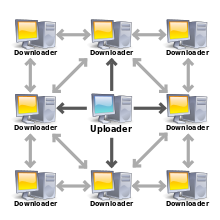
The heart figurer is acting every bit a "seed" to provide a file to the other computers which act equally peers
Programmer Bram Cohen, a University at Buffalo alumnus,[12] designed the protocol in April 2001, and released the first bachelor version on 2 July 2001.[4]
The commencement release of the BitTorrent client had no search engine and no peer exchange. Up until 2005, the only fashion to share files was by creating a pocket-size text file called a "torrent", that they would upload to a torrent index site. The get-go uploader acted as a seed, and downloaders would initially connect equally peers. Those who wish to download the file would download the torrent, which their client would utilise to connect to a tracker which had a list of the IP addresses of other seeds and peers in the swarm. Once a peer completed a download of the complete file, it could in plough function as a seed. These files contain metadata about the files to be shared and the trackers which keep track of the other seeds and peers.
In 2005, first Vuze and then the BitTorrent client introduced distributed tracking using distributed hash tables which immune clients to exchange data on swarms directly without the need for a torrent file.
In 2006, peer exchange functionality was added allowing clients to add peers based on the data plant on connected nodes.
BitTorrent v2 is intended to work seamlessly with previous versions of the BitTorrent protocol. The main reason for the update was that the one-time cryptographic hash function, SHA-one is no longer considered safe from malicious attacks past the developers, and every bit such, v2 uses SHA-256. To ensure backwards compatibility, the v2 .torrent file format supports a hybrid fashion where the torrents are hashed through both the new method and the former method, with the intent that the files volition be shared with peers on both v1 and v2 swarms. Another update to the specification is adding a hash tree to speed up time from adding a torrent to downloading files, and to allow more than granular checks for file corruption. In improver, each file is now hashed individually, enabling files in the swarm to exist deduplicated, so that if multiple torrents include the aforementioned files, but seeders are but seeding the file from some, downloaders of the other torrents tin however download the file. Magnet links for v2 also support a hybrid way to ensure back up for legacy clients.[xiii]
Blueprint [edit]
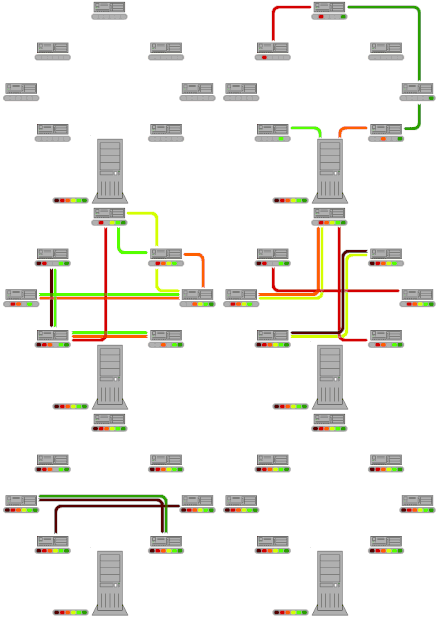
Animation of protocol utilise: The colored dots beneath each figurer in the animation represent dissimilar parts of the file being shared. By the time a copy to a destination calculator of each of those parts completes, a copy to some other destination computer of that part (or other parts) is already taking place betwixt users.
The BitTorrent protocol can exist used to reduce the server and network impact of distributing big files. Rather than downloading a file from a single source server, the BitTorrent protocol allows users to join a "swarm" of hosts to upload and download from each other simultaneously. The protocol is an culling to the older single source, multiple mirror sources technique for distributing data, and can piece of work effectively over networks with lower bandwidth. Using the BitTorrent protocol, several basic computers, such as dwelling computers, can replace large servers while efficiently distributing files to many recipients. This lower bandwidth usage also helps prevent large spikes in net traffic in a given area, keeping internet speeds higher for all users in full general, regardless of whether or not they utilize the BitTorrent protocol.
The file being distributed is divided into segments called pieces. As each peer receives a new piece of the file, it becomes a source (of that piece) for other peers, relieving the original seed from having to send that piece to every computer or user wishing a copy. With BitTorrent, the task of distributing the file is shared by those who want it; information technology is entirely possible for the seed to send only a single copy of the file itself and eventually distribute to an unlimited number of peers. Each piece is protected by a cryptographic hash independent in the torrent descriptor.[1] This ensures that whatsoever modification of the piece can exist reliably detected, and thus prevents both adventitious and malicious modifications of any of the pieces received at other nodes. If a node starts with an authentic copy of the torrent descriptor, it can verify the authenticity of the entire file it receives.
Pieces are typically downloaded non-sequentially, and are rearranged into the correct social club by the BitTorrent client, which monitors which pieces it needs, and which pieces it has and can upload to other peers. Pieces are of the same size throughout a single download (for case, a x MB file may be transmitted as ten 1 MB pieces or as forty 256 KB pieces). Due to the nature of this approach, the download of any file can exist halted at any time and be resumed at a afterward appointment, without the loss of previously downloaded data, which in plow makes BitTorrent specially useful in the transfer of larger files. This also enables the client to seek out readily available pieces and download them immediately, rather than halting the download and waiting for the next (and possibly unavailable) piece in line, which typically reduces the overall time of the download. This eventual transition from peers to seeders determines the overall "health" of the file (as adamant by the number of times a file is bachelor in its complete form).
The distributed nature of BitTorrent tin can lead to a overflowing-like spreading of a file throughout many peer estimator nodes. As more than peers join the swarm, the likelihood of a successful download by any particular node increases. Relative to traditional Cyberspace distribution schemes, this permits a significant reduction in the original distributor's hardware and bandwidth resource costs. Distributed downloading protocols in general provide redundancy against arrangement bug, reduce dependence on the original distributor,[14] and provide sources for the file which are generally transient and therefore there is no single bespeak of failure as in one way server-customer transfers.
Though both ultimately transfer files over a network, a BitTorrent download differs from a one style server-client download (as is typical with an HTTP or FTP request, for example) in several cardinal ways:
- BitTorrent makes many small-scale data requests over dissimilar IP connections to different machines, while server-customer downloading is typically fabricated via a single TCP connection to a single motorcar.
- BitTorrent downloads in a random or in a "rarest-first"[15] approach that ensures high availability, while classic downloads are sequential.
Taken together, these differences permit BitTorrent to reach much lower price to the content provider, much higher redundancy, and much greater resistance to corruption or to "flash crowds" than regular server software. All the same, this protection, theoretically, comes at a toll: downloads can take time to rise to full speed because it may take time for enough peer connections to exist established, and information technology may accept fourth dimension for a node to receive sufficient data to become an effective uploader. This contrasts with regular downloads (such as from an HTTP server, for example) that, while more vulnerable to overload and corruption, rise to full speed very apace, and maintain this speed throughout. In the beginning, BitTorrent's not-face-to-face download methods fabricated information technology harder to back up "streaming playback". In 2014, the client Popcorn Time allowed for streaming of BitTorrent video files. Since then, more and more clients are offering streaming options.
Searching [edit]
The BitTorrent protocol provides no manner to alphabetize torrent files. As a issue, a comparatively minor number of websites take hosted a big bulk of torrents, many linking to copyrighted works without the authorization of copyright holders, rendering those sites especially vulnerable to lawsuits.[16] A BitTorrent index is a "list of .torrent files, which typically includes descriptions" and information virtually the torrent'due south content.[17] Several types of websites support the discovery and distribution of information on the BitTorrent network. Public torrent-hosting sites such as The Pirate Bay let users to search and download from their collection of torrent files. Users can typically also upload torrent files for content they wish to distribute. Frequently, these sites also run BitTorrent trackers for their hosted torrent files, only these 2 functions are not mutually dependent: a torrent file could be hosted on one site and tracked past another unrelated site. Individual host/tracker sites operate similar public ones except that they may restrict admission to registered users and may also go along runway of the amount of data each user uploads and downloads, in an attempt to reduce "leeching".
Web search engines allow the discovery of torrent files that are hosted and tracked on other sites; examples include The Pirate Bay and BTDigg. These sites let the user to ask for content coming together specific criteria (such as containing a given word or phrase) and retrieve a list of links to torrent files matching those criteria. This list can often be sorted with respect to several criteria, relevance (seeders-leechers ratio) beingness one of the most pop and useful (due to the way the protocol behaves, the download bandwidth achievable is very sensitive to this value). Metasearch engines permit 1 to search several BitTorrent indices and search engines at once.
The Tribler BitTorrent client was among the first to incorporate built-in search capabilities. With Tribler, users tin can find .torrent files held by random peers and taste buddies.[18] It adds such an ability to the BitTorrent protocol using a gossip protocol, somewhat similar to the eXeem network which was close down in 2005. The software includes the ability to recommend content besides. After a dozen downloads, the Tribler software can roughly estimate the download taste of the user, and recommend boosted content.[19]
In May 2007, researchers at Cornell University published a paper proposing a new arroyo to searching a peer-to-peer network for inexact strings,[20] which could replace the functionality of a central indexing site. A year later on, the same team implemented the system equally a plugin for Vuze called Cubit[21] and published a follow-upwardly newspaper reporting its success.[22]
A somewhat like facility but with a slightly different approach is provided by the BitComet customer through its "Torrent Exchange"[23] characteristic. Whenever two peers using BitComet (with Torrent Exchange enabled) connect to each other they commutation lists of all the torrents (proper noun and info-hash) they have in the Torrent Share storage (torrent files which were previously downloaded and for which the user chose to enable sharing by Torrent Exchange). Thus each customer builds upwards a list of all the torrents shared by the peers information technology connected to in the current session (or it can fifty-fifty maintain the listing between sessions if instructed).
At whatsoever fourth dimension the user tin search into that Torrent Collection list for a sure torrent and sort the list by categories. When the user chooses to download a torrent from that listing, the .torrent file is automatically searched for (by info-hash value) in the DHT Network and when constitute it is downloaded by the querying client which can after that create and initiate a downloading chore.
Downloading and sharing [edit]
Users find a torrent of involvement on a torrent index site or by using a search engine built into the client, download it, and open it with a BitTorrent client. The client connects to the tracker(s) or seeds specified in the torrent file, from which it receives a list of seeds and peers currently transferring pieces of the file(southward). The customer connects to those peers to obtain the various pieces. If the swarm contains only the initial seeder, the customer connects directly to it, and begins to request pieces. Clients contain mechanisms to optimize their download and upload rates.
The effectiveness of this data exchange depends largely on the policies that clients use to determine to whom to send data. Clients may prefer to send data to peers that send data dorsum to them (a "tit for tat" exchange scheme), which encourages fair trading. But strict policies often consequence in suboptimal situations, such as when newly joined peers are unable to receive any information considering they don't have any pieces yet to trade themselves or when ii peers with a good connection between them do not exchange data merely because neither of them takes the initiative. To counter these effects, the official BitTorrent customer plan uses a mechanism called "optimistic unchoking", whereby the client reserves a portion of its bachelor bandwidth for sending pieces to random peers (not necessarily known adept partners, so chosen preferred peers) in hopes of discovering even better partners and to ensure that newcomers get a run a risk to join the swarm.[24]
Although "swarming" scales well to tolerate "flash crowds" for popular content, it is less useful for unpopular or niche market content. Peers arriving after the initial rush might observe the content unavailable and demand to wait for the arrival of a "seed" in order to consummate their downloads. The seed arrival, in turn, may take long to happen (this is termed the "seeder promotion problem"). Since maintaining seeds for unpopular content entails high bandwidth and administrative costs, this runs counter to the goals of publishers that value BitTorrent equally a cheap alternative to a client-server approach. This occurs on a huge scale; measurements take shown that 38% of all new torrents get unavailable within the commencement month.[25] A strategy adopted past many publishers which significantly increases availability of unpopular content consists of bundling multiple files in a single swarm.[26] More sophisticated solutions have also been proposed; generally, these use cross-torrent mechanisms through which multiple torrents can cooperate to better share content.[27]
Creating and publishing [edit]
| | This article needs to be updated. The reason given is: Some extensions described in this section as experimental accept been standardized. This section is factually incorrect nigh some aspects of v1 and v2.. (January 2022) |

The peer distributing a data file treats the file as a number of identically sized pieces, usually with byte sizes of a power of 2, and typically between 32 kB and sixteen MB each. The peer creates a hash for each piece, using the SHA-1 hash part, and records it in the torrent file. Pieces with sizes greater than 512 kB volition reduce the size of a torrent file for a very large payload, but is claimed to reduce the efficiency of the protocol.[28] When another peer later receives a particular piece, the hash of the slice is compared to the recorded hash to examination that the piece is mistake-free.[1] Peers that provide a complete file are called seeders, and the peer providing the initial re-create is called the initial seeder. The exact information contained in the torrent file depends on the version of the BitTorrent protocol.
By convention, the name of a torrent file has the suffix .torrent. Torrent files accept an "announce" section, which specifies the URL of the tracker, and an "info" section, containing (suggested) names for the files, their lengths, the piece length used, and a SHA-1 hash code for each piece, all of which are used by clients to verify the integrity of the data they receive. Though SHA-i has shown signs of cryptographic weakness, Bram Cohen did not initially consider the take a chance large enough for a astern incompatible change to, for example, SHA-3. As of BitTorrent v2 the hash part has been updated to SHA-256.[29]
In the early days, torrent files were typically published to torrent index websites, and registered with at least one tracker. The tracker maintained lists of the clients currently connected to the swarm.[1] Alternatively, in a trackerless organization (decentralized tracking) every peer acts as a tracker. Azureus was the showtime[30] BitTorrent client to implement such a system through the distributed hash table (DHT) method. An culling and incompatible DHT system, known every bit Mainline DHT, was released in the Mainline BitTorrent customer 3 weeks later (though it had been in development since 2002)[xxx] and subsequently adopted by the μTorrent, Transmission, rTorrent, KTorrent, BitComet, and Deluge clients.
After the DHT was adopted, a "private" flag – analogous to the broadcast flag – was unofficially introduced, telling clients to restrict the apply of decentralized tracking regardless of the user'due south desires.[31] The flag is intentionally placed in the info department of the torrent so that information technology cannot be disabled or removed without irresolute the identity of the torrent. The purpose of the flag is to prevent torrents from existence shared with clients that do not have admission to the tracker. The flag was requested for inclusion in the official specification in August 2008, simply has not been accepted still.[32] Clients that take ignored the private flag were banned past many trackers, discouraging the practice.[33]
Anonymity [edit]
BitTorrent does non, on its own, offer its users anonymity. One can usually see the IP addresses of all peers in a swarm in one'southward ain customer or firewall plan. This may betrayal users with insecure systems to attacks.[24] In some countries, copyright organizations scrape lists of peers, and send takedown notices to the internet service provider of users participating in the swarms of files that are under copyright. In some jurisdictions, copyright holders may launch lawsuits against uploaders or downloaders for infringement, and police may arrest suspects in such cases.
Various ways have been used to promote anonymity. For example, the BitTorrent customer Tribler makes bachelor a Tor-like onion network, optionally routing transfers through other peers to obscure which client has requested the data. The exit node would be visible to peers in a swarm, simply the Tribler organization provides exit nodes. One reward of Tribler is that clearnet torrents tin can be downloaded with only a small decrease in download speed from one "hop" of routing.
i2p provides a similar anonymity layer although in that case, 1 can only download torrents that have been uploaded to the i2p network.[34] The bittorrent client Vuze allows users who are not concerned about anonymity to take clearnet torrents, and make them bachelor on the i2p network.[35]
Near BitTorrent clients are not designed to provide anonymity when used over Tor,[36] and there is some argue as to whether torrenting over Tor acts as a drag on the network.[37]
Private torrent trackers are usually invitation but, and require members to participate in uploading, but have the downside of a unmarried centralized signal of failure. Oink'south Pink Palace and What.cd are examples of private trackers which have been shut downwards.
Seedbox services download the torrent files first to the company's servers, assuasive the user to direct download the file from there.[38] [39] 1's IP address would be visible to the Seedbox provider, but non to tertiary parties.
Virtual private networks encrypt transfers, and substitute a different IP address for the user'due south, and then that anyone monitoring a torrent swarm will merely see that address.
Associated technologies [edit]
Distributed trackers [edit]
On two May 2005, Azureus 2.3.0.0 (now known as Vuze) was released,[forty] introducing support for "trackerless" torrents through a organisation called the "distributed database." This system is a Distributed hash tabular array implementation which allows the customer to use torrents that practice not accept a working BitTorrent tracker. Instead only bootstrapping server is used (router.bittorrent.com, dht.transmissionbt.com or router.utorrent.com[41] [42]). The following month, BitTorrent, Inc. released version 4.ii.0 of the Mainline BitTorrent client, which supported an culling DHT implementation (popularly known every bit "Mainline DHT", outlined in a typhoon on their website) that is incompatible with that of Azureus. In 2014, measurement showed concurrent users of Mainline DHT to be from 10 million to 25 million, with a daily churn of at least 10 million.[43]
Current versions of the official BitTorrent client, μTorrent, BitComet, Transmission and BitSpirit all share compatibility with Mainline DHT. Both DHT implementations are based on Kademlia.[44] As of version 3.0.5.0, Azureus also supports Mainline DHT in addition to its ain distributed database through employ of an optional awarding plugin.[45] This potentially allows the Azureus/Vuze client to reach a bigger swarm.
Another thought that has surfaced in Vuze is that of virtual torrents. This idea is based on the distributed tracker arroyo and is used to describe some web resource. Currently, information technology is used for instant messaging. It is implemented using a special messaging protocol and requires an advisable plugin. Anatomic P2P is another approach, which uses a decentralized network of nodes that route traffic to dynamic trackers. Nigh BitTorrent clients also utilise Peer exchange (PEX) to gather peers in addition to trackers and DHT. Peer substitution checks with known peers to see if they know of any other peers. With the 3.0.5.0 release of Vuze, all major BitTorrent clients now have uniform peer exchange.
Web seeding [edit]
Web "seeding" was implemented in 2006 equally the ability of BitTorrent clients to download torrent pieces from an HTTP source in addition to the "swarm". The reward of this feature is that a website may distribute a torrent for a particular file or batch of files and brand those files available for download from that same web server; this can simplify long-term seeding and load balancing through the utilize of existing, inexpensive, spider web hosting setups. In theory, this would make using BitTorrent almost every bit easy for a web publisher as creating a direct HTTP download. In improver, it would let the "web seed" to be disabled if the swarm becomes too popular while still allowing the file to exist readily available. This feature has two distinct specifications, both of which are supported past Libtorrent and the 26+ clients that apply information technology.
The first was created by John "TheSHAD0W" Hoffman, who created BitTornado.[46] [47] This first specification requires running a web service that serves content by info-hash and piece number, rather than filename.
The other specification is created by GetRight authors and tin rely on a basic HTTP download space (using byte serving).[48] [49]
In September 2010, a new service named Burnbit was launched which generates a torrent from any URL using webseeding.[50] There are server-side solutions that provide initial seeding of the file from the web server via standard BitTorrent protocol and when the number of external seeders reach a limit, they finish serving the file from the original source.[51]
[edit]
A technique called broadcatching combines RSS feeds with the BitTorrent protocol to create a content delivery system, further simplifying and automating content distribution. Steve Gillmor explained the concept in a column for Ziff-Davis in December 2003.[52] The discussion spread apace among bloggers (Ernest Miller,[53] Chris Pirillo, etc.). In an article entitled Broadcatching with BitTorrent, Scott Raymond explained:
I want RSS feeds of BitTorrent files. A script would periodically check the feed for new items, and use them to start the download. And so, I could find a trusted publisher of an Alias RSS feed, and "subscribe" to all new episodes of the show, which would then start downloading automatically – like the "flavor laissez passer" feature of the TiVo.
—Scott Raymond, scottraymond.cyberspace[54]
The RSS feed will track the content, while BitTorrent ensures content integrity with cryptographic hashing of all information, so feed subscribers will receive uncorrupted content. I of the first and popular software clients (free and open source) for broadcatching is Miro. Other free software clients such as PenguinTV and KatchTV are likewise now supporting broadcatching. The BitTorrent web-service MoveDigital added the ability to make torrents bachelor to any spider web awarding capable of parsing XML through its standard Rest-based interface in 2006,[55] though this has since been discontinued. Additionally, Torrenthut is developing a similar torrent API that will provide the same features, and help bring the torrent community to Spider web 2.0 standards. Aslope this release is a kickoff PHP application congenital using the API called PEP, which will parse any Really Simple Syndication (RSS 2.0) feed and automatically create and seed a torrent for each enclosure plant in that feed.[56]
Throttling and encryption [edit]
Since BitTorrent makes upward a large proportion of total traffic, some ISPs take called to "throttle" (deadening down) BitTorrent transfers. For this reason, methods have been developed to disguise BitTorrent traffic in an endeavour to thwart these efforts.[57] Protocol header encrypt (PHE) and Message stream encryption/Protocol encryption (MSE/PE) are features of some BitTorrent clients that endeavor to make BitTorrent hard to detect and throttle. As of November 2015, Vuze, Bitcomet, KTorrent, Transmission, Deluge, μTorrent, MooPolice, Halite, qBittorrent, rTorrent, and the latest official BitTorrent client (v6) back up MSE/PE encryption.
In August 2007, Comcast was preventing BitTorrent seeding by monitoring and interfering with the communication between peers. Protection against these efforts is provided by proxying the customer-tracker traffic via an encrypted tunnel to a point outside of the Comcast network.[58] In 2008, Comcast called a "truce" with BitTorrent, Inc. with the intention of shaping traffic in a protocol-agnostic manner.[59] Questions about the ethics and legality of Comcast's behavior have led to renewed debate most net neutrality in the United States.[sixty] In general, although encryption can make it hard to determine what is being shared, BitTorrent is vulnerable to traffic assay. Thus, even with MSE/PE, information technology may be possible for an Internet access provider to recognize BitTorrent and also to determine that a system is no longer downloading but only uploading data, and terminate its connectedness past injecting TCP RST (reset flag) packets.
Multitrackers [edit]
Another unofficial feature is an extension to the BitTorrent metadata format proposed past John Hoffman[61] and implemented by several indexing websites. It allows the use of multiple trackers per file, then if one tracker fails, others can go on to back up file transfer. It is implemented in several clients, such as BitComet, BitTornado, BitTorrent, KTorrent, Transmission, Drench, μTorrent, rtorrent, Vuze, and Frostwire. Trackers are placed in groups, or tiers, with a tracker randomly chosen from the top tier and tried, moving to the next tier if all the trackers in the top tier fail.
Torrents with multiple trackers tin decrease the time information technology takes to download a file, but besides have a few consequences:
- Poorly implemented[62] clients may contact multiple trackers, leading to more overhead-traffic.
- Torrents from airtight trackers all of a sudden get downloadable by non-members, as they tin can connect to a seed via an open tracker.
Peer choice [edit]
As of Dec 2008,[update] BitTorrent, Inc. was working with Oversi on new Policy Detect Protocols that query the ISP for capabilities and network architecture information. Oversi'due south Internet access provider hosted NetEnhancer box is designed to "improve peer choice" by helping peers find local nodes, improving download speeds while reducing the loads into and out of the ISP'south network.[63]
Implementations [edit]
The BitTorrent specification is free to use and many clients are open source, so BitTorrent clients have been created for all mutual operating systems using a diverseness of programming languages. The official BitTorrent client, μTorrent, qBittorrent, Transmission, Vuze, and BitComet are some of the nigh pop clients.[64] [65] [66] [67]
Some BitTorrent implementations such equally MLDonkey and Torrentflux are designed to run equally servers. For example, this can be used to centralize file sharing on a single dedicated server which users share access to on the network.[68] Server-oriented BitTorrent implementations can also exist hosted past hosting providers at co-located facilities with high bandwidth Internet connectivity (e.one thousand., a datacenter) which tin can provide dramatic speed benefits over using BitTorrent from a regular home broadband connection. Services such equally ImageShack can download files on BitTorrent for the user, allowing them to download the entire file by HTTP in one case it is finished.
The Opera spider web browser supports BitTorrent natively.[69] Brave spider web browser ships with an extension which supports WebTorrent, a BitTorrent-like protocol based on WebRTC instead of UDP and TCP.[70] [71] BitLet allowed users to download Torrents directly from their browser using a Java applet (until browsers removed support for Java applets).[72] [ citation needed ] An increasing number of hardware devices are being made to support BitTorrent. These include routers and NAS devices containing BitTorrent-capable firmware like OpenWrt. Proprietary versions of the protocol which implement DRM, encryption, and hallmark are found within managed clients such every bit Pando.
Adoption [edit]
A growing number of individuals and organizations are using BitTorrent to distribute their own or licensed works (e.g. indie bands distributing digital files of their new songs). Independent adopters report that BitTorrent technology reduces demands on private networking hardware and bandwidth, an essential for non-profit groups with large amounts of internet traffic.[73]
Some uses of BitTorrent for file sharing may violate laws in some jurisdictions (encounter legislation section).
Film, video, and music [edit]
- BitTorrent Inc. has obtained a number of licenses from Hollywood studios for distributing popular content from their websites.[ citation needed ]
- Sub Pop Records releases tracks and videos via BitTorrent Inc.[74] to distribute its 1000+ albums. Babyshambles and The Libertines (both bands associated with Pete Doherty) take extensively used torrents to distribute hundreds of demos and alive videos. US industrial rock band Nine Inch Nails often distributes albums via BitTorrent.
- Podcasting software is starting to integrate BitTorrent to help podcasters deal with the download demands of their MP3 "radio" programs. Specifically, Juice and Miro (formerly known as Democracy Role player) support automatic processing of .torrent files from RSS feeds. Similarly, some BitTorrent clients, such as μTorrent, are able to process spider web feeds and automatically download content plant within them.
- DGM Alive purchases are provided via BitTorrent.[75]
- VODO, a service which distributes "free-to-share" movies and TV shows via BitTorrent.[76] [77] [78]
Broadcasters [edit]
- In 2008, the CBC became the kickoff public broadcaster in North America to make a full show (Canada's Side by side Great Prime Minister) available for download using BitTorrent.[79]
- The Norwegian Dissemination Corporation (NRK) has since March 2008 experimented with bittorrent distribution, bachelor online.[80] Just selected works in which NRK owns all royalties are published. Responses have been very positive, and NRK is planning to offering more than content.
- The Dutch VPRO broadcasting organization released four documentaries in 2009 and 2010 under a Creative Eatables license using the content distribution characteristic of the Mininova tracker.[81] [82] [83]
Deject Service Providers [edit]
- The Amazon AWS's Uncomplicated Storage Service (S3), until April 29, 2021, had supported sharing of saucepan objects with BitTorrent protocols. As of June 13, 2020, the characteristic is only available in service regions launched after May 30, 2016.[84] [85] [86] The characteristic for the existing customers will be extended for an additional 12 months following the deprecation. Afterward April 29, 2022, BitTorrent clients will no longer connect to Amazon S3.
Software [edit]
- Blizzard Entertainment uses BitTorrent (via a proprietary client called the "Blizzard Downloader", associated with the Blizzard "BattleNet" network) to distribute content and patches for Diablo Three, StarCraft Ii and World of Warcraft, including the games themselves.[87]
- Wargaming uses BitTorrent in their popular titles World of Tanks, Globe of Warships and World of Warplanes to distribute game updates.[88]
- CCP Games, maker of the space simulation MMORPG Eve Online, has announced that a new launcher volition exist released that is based on BitTorrent.[89] [xc]
- Many software games, especially those whose big size makes them difficult to host due to bandwidth limits, extremely frequent downloads, and unpredictable changes in network traffic, will distribute instead a specialized, stripped down BitTorrent client with enough functionality to download the game from the other running clients and the main server (which is maintained in case non enough peers are bachelor).
- Many major open source and complimentary software projects encourage BitTorrent likewise as conventional downloads of their products (via HTTP, FTP etc.) to increase availability and to reduce load on their own servers, peculiarly when dealing with larger files.[91]
- Resilio Sync is a BitTorrent-based[92] folder-syncing tool which tin can deed as an alternative to server-based synchronisation services such as Dropbox.
Authorities [edit]
- The British regime used BitTorrent to distribute details about how the taxation money of British citizens was spent.[93] [94]
Education [edit]
- Florida State University uses BitTorrent to distribute big scientific data sets to its researchers.[95]
- Many universities that take BOINC distributed calculating projects take used the BitTorrent functionality of the client-server organization to reduce the bandwidth costs of distributing the client-side applications used to procedure the scientific data. If a BOINC distributed computing application needs to exist updated (or merely sent to a user), it tin can exercise so with little bear on on the BOINC server.[96]
- The developing Human Connectome Project uses BitTorrent to share their open dataset.[97]
- Academic Torrents is a BitTorrent tracker for utilise by researchers in fields that need to share big datasets[98] [99]
Others [edit]
- Facebook uses BitTorrent to distribute updates to Facebook servers.[100]
- Twitter uses BitTorrent to distribute updates to Twitter servers.[101] [102]
- The Internet Archive added BitTorrent to its file download options for over ane.3 meg existing files, and all newly uploaded files, in August 2012.[103] [104] This method is the fastest means of downloading media from the Archive.[103] [105]
By early 2015, AT&T estimated that BitTorrent accounted for xx% of all broadband traffic.[106]
Routers that apply network address translation (NAT) must maintain tables of source and destination IP addresses and ports. Because BitTorrent often contacts twenty–30 servers per 2d, the NAT tables of some consumer-grade routers are rapidly filled. This is a known cause of some abode routers ceasing to work correctly.[107] [108]
Legislation [edit]
Although the protocol itself is legal,[109] bug stem from using the protocol to traffic copyright infringing works, since BitTorrent is often used to download otherwise paid content, such every bit movies and video games. There has been much controversy over the use of BitTorrent trackers. BitTorrent metafiles themselves practice not shop file contents. Whether the publishers of BitTorrent metafiles violate copyrights by linking to copyrighted works without the potency of copyright holders is controversial. Various jurisdictions take pursued legal action confronting websites that host BitTorrent trackers.
High-profile examples include the closing of Suprnova.org, TorrentSpy, LokiTorrent, BTJunkie, Mininova, Oink's Pink Palace and What.cd. BitTorrent search engine The Pirate Bay torrent website, formed by a Swedish group, is noted for the "legal" section of its website in which letters and replies on the field of study of alleged copyright infringements are publicly displayed. On 31 May 2006, The Pirate Bay's servers in Sweden were raided by Swedish police on allegations by the MPAA of copyright infringement;[110] however, the tracker was up and running over again three days later. In the study used to value NBC Universal in its merger with Comcast, Envisional examined the 10,000 torrent swarms managed past PublicBT which had the most active downloaders. After excluding pornographic and unidentifiable content, it was found that only one swarm offered legitimate content.[111]
In the United states of america, more than 200,000 lawsuits have been filed for copyright infringement on BitTorrent since 2010.[112] In the United kingdom of great britain and northern ireland, on 30 April 2012, the High Courtroom of Justice ordered five ISPs to cake The Pirate Bay.[113]
Security [edit]
One concern is the UDP flood attack. BitTorrent implementations oft use μTP for their advice. To achieve high bandwidths, the underlying protocol used is UDP, which allows spoofing of source addresses of internet traffic. Information technology has been possible to behave out Denial-of-service attacks in a P2P lab environment, where users running BitTorrent clients act equally amplifiers for an assault at another service.[114] Even so this is not always an constructive assault because ISPs can bank check if the source address is right.
Several studies on BitTorrent establish files bachelor for download containing malware. In particular, one minor sample indicated that 18% of all executable programs bachelor for download contained malware.[115] Another study claims that equally much equally 14.5% of BitTorrent downloads comprise zero-day malware, and that BitTorrent was used as the distribution mechanism for 47% of all zippo-day malware they have establish.[116]
Meet also [edit]
- Bearding P2P
- Anti-Counterfeiting Trade Understanding
- Bencode
- Cache Discovery Protocol
- Comparison of BitTorrent clients
- Comparison of BitTorrent sites
- Comparing of BitTorrent tracker software
- Glossary of BitTorrent terms
- Magnet URI scheme
- Elementary file verification
- Super-seeding
- Torrent poisoning
References [edit]
- ^ a b c d Cohen, Bram (October 2002). "BitTorrent Protocol 1.0". BitTorrent.org. Archived from the original on eight February 2014. Retrieved one June 2020.
- ^ Van der Sar, Ernesto (four Dec 2009). "Thunder Blasts uTorrent's Market place Share Away - TorrentFreak". TorrentFreak. Archived from the original on 20 February 2016. Retrieved eighteen June 2018.
- ^ "迅雷-全球共享计算与区块链创领者". Xunlei.com. Archived from the original on eighteen November 2019. Retrieved 21 Nov 2019.
- ^ a b Cohen, Bram (2 July 2001). "BitTorrent – a new P2P app". Yahoo eGroups. Archived from the original on 29 Jan 2008. Retrieved 15 Apr 2007.
- ^ "Merge pull request #59 from the8472/new-hash-algos". BitTorrent. 15 May 2017. Archived from the original on 10 November 2021. Retrieved 13 September 2021.
- ^ Cohen, Bram. "The BitTorrent Protocol Specification v2". BitTorrent.org. BitTorrent. Archived from the original on 12 November 2020. Retrieved 28 October 2020.
- ^ Norberg, Arvid (7 September 2020). "Bittorrent-v2". libtorrent.org. libtorrent. Archived from the original on xxx October 2020. Retrieved 28 Oct 2020.
- ^ "Application Usage & Threat Report". Palo Alto Networks. 2013. Archived from the original on 31 October 2013. Retrieved 7 April 2013.
- ^ Marozzo, Fabrizio; Talia, Domenico; Trunfio, Paolo (2020). "A Slumber-and-Wake technique for reducing energy consumption in BitTorrent networks". Concurrency and Ciphering: Practice and Experience. 32 (xiv). doi:10.1002/cpe.5723. ISSN 1532-0634. S2CID 215841734.
- ^ Wang, Liang; Kangasharju, J. (i September 2013). "Measuring large-calibration distributed systems: Case of Bit Torrent Mainline DHT". IEEE P2P 2013 Proceedings. pp. i–x. doi:10.1109/P2P.2013.6688697. ISBN978-i-4799-0515-7. S2CID 5659252. Archived from the original on eighteen November 2015. Retrieved seven January 2016.
- ^ "BitTorrent and μTorrent Software Surpass 150 Million User Milestone". Bittorrent.com. 9 January 2012. Archived from the original on 26 March 2014. Retrieved ix July 2012.
- ^ "UB Engineering Tweeter". University at Buffalo's Schoolhouse of Technology and Applied Sciences. Archived from the original on 11 Nov 2013. Retrieved iv Jan 2022.
- ^ "Bittorrent-v2". libbittorrent.org. libbittorrent. Archived from the original on xxx October 2020. Retrieved 28 October 2020.
- ^ Menasche, Daniel South.; Rocha, Antonio A. A.; de Souza eastward Silva, Edmundo A.; Leao, Rosa 1000.; Towsley, Don; Venkataramani, Arun (2010). "Estimating Self-Sustainability in Peer-to-Peer Swarming Systems". Performance Evaluation. 67 (11): 1243–1258. arXiv:1004.0395. doi:10.1016/j.peva.2010.08.013. S2CID 9361889. past D. Menasche, A. Rocha, E. de Souza e Silva, R. One thousand. Leao, D. Towsley, A. Venkataramani.
- ^ Urvoy-Keller (December 2006). "Rarest First and Choke Algorithms Are Enough" (PDF). SIGCOMM. Archived (PDF) from the original on 23 May 2012. Retrieved 9 March 2012.
- ^ Ernesto (12 July 2009). "PublicBT Tracker Set To Patch BitTorrent' Achilles' Heel". Torrentfreak. Archived from the original on 26 March 2014. Retrieved 14 July 2009.
- ^ Chwan-Hwa (John) Wu, J. David Irwin. Introduction to Computer Networks and Cybersecurity. Chapter 5.4.: Partially Centralized Architectures. CRC Press. iv Feb 2013. ISBN 9781466572133
- ^ Zeilemaker, N., Capotă, M., Bakker, A., & Pouwelse, J. (2011). "Tribler P2P Media Search and Sharing." Proceedings of the 19th ACM International Conference on Multimedia - MM '11.
- ^ "DecentralizedRecommendation –". Tribler.org. Archived from the original on 2 Dec 2008. Retrieved 9 July 2012.
- ^ Wong, Bernard; Vigfusson, Ymir; Gun Sirer, Emin (2 May 2007). "Hyperspaces for Object Clustering and Judge Matching in Peer-to-Peer Overlays" (PDF). Cornell University. Archived (PDF) from the original on 17 June 2012. Retrieved seven April 2013.
- ^ Wong, Bernard (2008). "Cubit: Judge Matching for Peer-to-Peer Overlays". Cornell University. Archived from the original on 31 December 2012. Retrieved 26 May 2008.
- ^ Wong, Bernard. "Approximate Matching for Peer-to-Peer Overlays with Cubit" (PDF). Cornell University. Archived (PDF) from the original on 29 October 2008. Retrieved 26 May 2008.
- ^ "Torrent Commutation". Archived from the original on v October 2013. Retrieved 31 Jan 2010.
The torrent sharing feature of BitComet. Bitcomet.com.
- ^ a b Tamilmani, Karthik (25 October 2003). "Studying and enhancing the BitTorrent protocol". Stony Brook University. Archived from the original (DOC) on 19 November 2004. Retrieved vi May 2006.
- ^ Kaune, Sebastian; et al. (2009). "Unraveling BitTorrent's File Unavailability: Measurements and Analysis". arXiv:0912.0625 [cs.NI].
- ^ D. Menasche; et al. (1–4 Dec 2009). Content Availability and Bundling in Swarming Systems (PDF). CoNEXT'09. Rome, Italy: ACM via sigcomm.org. ISBN978-1-60558-636-6. Archived (PDF) from the original on 1 May 2011. Retrieved xviii December 2009.
- ^ Kaune, Sebastian; et al. "The Seeder Promotion Problem: Measurements, Analysis and Solution Space" (PDF). Queen Mary's University London. Archived (PDF) from the original on ix Baronial 2014. Retrieved twenty July 2017.
- ^ "BitTorrent Specification". Wiki.theory.org. Archived from the original on 26 June 2013. Retrieved 9 July 2012. [ dubious ]
- ^ "» BitTorrent v2". Archived from the original on 27 September 2020. Retrieved 27 September 2020.
- ^ a b Jones, Ben (vii June 2015). "BitTorrent's DHT Turns 10 Years Old". TorrentFreak. Archived from the original on 11 June 2015. Retrieved 5 July 2015.
- ^ "Unofficial BitTorrent Protocol Specification v1.0". Archived from the original on 14 December 2006. Retrieved iv October 2009. [ dubious ]
- ^ Harrison, David (3 August 2008). "Private Torrents". Bittorrent.org. Archived from the original on 24 March 2013. Retrieved 4 Oct 2009.
- ^ "BitComet Banned From Growing Number of Private Trackers". Archived from the original on 26 March 2014. Retrieved 4 October 2009.
- ^ "I2P Compared to Tor - I2P". Archived from the original on 22 Dec 2015. Retrieved xvi December 2015.
- ^ "I2PHelper HowTo - VuzeWiki". Archived from the original on 20 October 2017. Retrieved sixteen December 2015.
- ^ "Bittorrent over Tor isn't a good idea - The Tor Blog". Archived from the original on 13 October 2016. Retrieved ii October 2016.
- ^ Inc., The Tor Project. "Tor Project: FAQ". Archived from the original on 22 October 2016. Retrieved 2 October 2016.
- ^ "This Website Could Be The Ultimate All-In-One Torrent Machine". viii April 2016. Archived from the original on 8 April 2016.
- ^ "Torrent From the Cloud With Seedr - TorrentFreak". 17 January 2016. Archived from the original on 19 April 2016. Retrieved 8 April 2016.
- ^ "Vuze Changelog". Azureus.sourceforge.internet. Archived from the original on ane December 2006.
- ^ "DHT Bootstrap Update | The BitTorrent Applied science Blog". engineering.bittorrent.com. Archived from the original on fourteen December 2019. Retrieved 21 Nov 2019.
- ^ GitHub - bittorrent/bootstrap-dht: DHT bootstrap server, BitTorrent Inc., 11 November 2019, archived from the original on 14 Jan 2020, retrieved 21 Nov 2019
- ^ Wang, Liang; Kangasharju, Jussi. (2013). "Measuring Large-Scale Distributed Systems: Example of BitTorrent Mainline DHT" (PDF). IEEE Peer-to-Peer. Archived (PDF) from the original on 12 May 2014. Retrieved 15 May 2014.
- ^ "Khashmir.SourceForge.net". Khashmir.SourceForge.net. Archived from the original on 2 July 2012. Retrieved nine July 2012.
- ^ "plugins.vuze.com". plugins.vuze.com. Archived from the original on 1 August 2012. Retrieved nine July 2012.
- ^ "HTTP-Based Seeding Specification". BitTornado.com. Archived from the original (TXT) on 20 March 2004. Retrieved 9 May 2006.
- ^ John Hoffman, DeHackEd (25 February 2008). "HTTP Seeding – BitTorrent Enhancement Proposal № 17". Archived from the original on xiii Dec 2013. Retrieved 17 February 2012.
- ^ "HTTP/FTP Seeding for BitTorrent". GetRight.com. Archived from the original on 28 Dec 2009. Retrieved xviii March 2010.
- ^ Michael Burford (25 February 2008). "WebSeed – HTTP/FTP Seeding (GetRight style) – BitTorrent Enhancement Proposal № 19". Bittorrent.org. Archived from the original on thirteen December 2013. Retrieved 17 February 2012.
- ^ "Burn Whatever Spider web-Hosted File into a Torrent With Burnbit". TorrentFreak. thirteen September 2010. Archived from the original on 9 Baronial 2011. Retrieved 9 July 2012.
- ^ "PHP based torrent file creator, tracker and seed server". PHPTracker. Archived from the original on 19 December 2013. Retrieved ix July 2012.
- ^ Gillmor, Steve (thirteen Dec 2003). "BitTorrent and RSS Create Disruptive Revolution". EWeek.com. 14 December 2003. Retrieved 22 April 2007.
- ^ Miller, Ernest (two March 2004). "BitTorrent + RSS = The New Broadcast". Archived from the original on 23 October 2013. . The Importance of... Corante.com.
- ^ Raymond, Scott (sixteen December 2003). "Broadcatching with BitTorrent". scottraymond.net. Archived from the original on 13 February 2004.
- ^ "MoveDigital API REST functions". Move Digital. 2006. Archived from the original on xi Baronial 2006. Retrieved 9 May 2006. Documentation.
- ^ "Prodigem Enclosure Puller(pep.txt)". Prodigem.com. Archived from the original (TXT) on 26 May 2006. Retrieved 9 May 2006. via Net Wayback Motorcar.
- ^ "Encrypting Bittorrent to take out traffic shapers". Torrentfreak.com. 5 February 2006. Archived from the original on 26 March 2014. Retrieved ix May 2006.
- ^ "Comcast Throttles BitTorrent Traffic, Seeding Incommunicable". Archived from the original on xi October 2013. , TorrentFreak, 17 August 2007.
- ^ Broache, Anne (27 March 2008). "Comcast and BitTorrent Agree to Collaborate". News.com. Archived from the original on 9 May 2008. Retrieved nine July 2012.
- ^ Soghoian, Chris (4 September 2007). "Is Comcast's BitTorrent filtering violating the constabulary?". Cnet.com. Archived from the original on 15 July 2010. Retrieved 9 July 2012.
- ^ "BEP12: Multitracker Metadata Extension". BitTorrent Inc. Archived from the original on 27 Dec 2012. Retrieved 28 March 2013.
- ^ "P2P:Protocol:Specifications:Multitracker". wiki.depthstrike.com. Archived from the original on 26 March 2014. Retrieved 13 November 2009. [ dubious ]
- ^ Johnston, Casey (ix Dec 2008). "Arstechnica.com". Arstechnica.com. Archived from the original on 12 December 2008. Retrieved ix July 2012.
- ^ Van Der Sar, Ernesto (iv December 2009). "Thunder Blasts uTorrent'south Market Share Away". TorrentFreak. Archived from the original on 7 December 2009. Retrieved 15 September 2011.
- ^ "uTorrent Dominates BitTorrent Client Market Share". TorrentFreak. 24 June 2009. Archived from the original on 3 April 2014. Retrieved 25 June 2013.
- ^ "Windows Public File Sharing Marketplace Share 2015". opswat. Archived from the original on xiv Apr 2016. Retrieved 1 April 2016.
- ^ Henry, Alan. "Near Popular BitTorrent Customer 2015". lifehacker. Archived from the original on nine April 2016. Retrieved one April 2016.
- ^ "Torrent Server combines a file server with P2P file sharing". Turnkeylinux.org. Archived from the original on vii July 2012. Retrieved 9 July 2012.
- ^ Anderson, Nate (1 February 2007). "Does network neutrality mean an end to BitTorrent throttling?". Ars Technica, LLC. Archived from the original on 16 December 2008. Retrieved 9 February 2007.
- ^ Mark (7 May 2020). "How to Stream Movies and Download Torrent Files in Brave Browser". Browser Pulse. Archived from the original on ix October 2020. Retrieved 6 October 2020.
- ^ "What extensions are built into Brave?". Brave Help Center. Archived from the original on viii January 2022. Retrieved 8 January 2022.
- ^ Bahgat, Alessandro (10 October 2008). "BitLet - Bittorrent applet". Alessandro Bahgat. Archived from the original on 21 November 2021. Retrieved 8 January 2022.
- ^ Run across for example "8 Legal Uses for BitTorrent". 17 Baronial 2013. Archived from the original on five May 2021. The Internet Annal
- ^ "Sub Pop page on BitTorrent.com". Archived from the original on 14 January 2007. Retrieved 13 Dec 2006.
- ^ "DGMlive.com". DGMlive.com. Archived from the original on 11 November 2013. Retrieved ix July 2012.
- ^ "VODO – About...". Retrieved xv April 2012. (WebCite).
- ^ Cory Doctorow (fifteen Oct 2009). "Vodo: a filesharing service for moving-picture show-makers". Boing Boing. Happy Mutants LLC. Retrieved 15 April 2012. (WebCite)
- ^ Ernesto. "Pioneer 1, The BitTorrent Exclusive Tv-Series Continues". TorrentFreak. Retrieved 15 Apr 2012. (WebCite)
- ^ "CBC to BitTorrent Canada's Next Great Prime Minister". CBC News. 19 March 2008. Archived from the original on 14 June 2010. Retrieved xix March 2008.
- ^ "Bittorrent" (in Norwegian). Nrkbeta.no. 2008. Archived from the original on 24 October 2013. Retrieved 7 April 2013.
- ^ "Torrents uploaded past EeuwvandeStad". MiniNova. 2009. Archived from the original on 4 November 2013. Retrieved seven April 2013.
- ^ Denters, M. (11 August 2010). "Tegenlicht – Download California Dreaming". VPRO.nl. Archived from the original on 26 March 2014. Retrieved seven April 2013.
- ^ Bol, M. (1 Oct 2009). "Tegenlicht – VPRO gemeengoed" (in Dutch). VPRO.nl. Archived from the original on 26 March 2014. Retrieved vii April 2013.
- ^ "Announcements well-nigh S3 BitTorrent discontinuation shouldn't exist buried in the commit history · Upshot #27 · awsdocs/amazon-s3-userguide". GitHub. Archived from the original on xxx September 2021. Retrieved thirty September 2021.
- ^ "Periodic update - 2021-05-xiii · awsdocs/amazon-s3-userguide@0d17598". GitHub. Archived from the original on thirty September 2021. Retrieved 30 September 2021.
- ^ "Using BitTorrent with Amazon S3 - Amazon Unproblematic Storage Service". xiii June 2020. Archived from the original on xiii June 2020. Retrieved 30 September 2021.
- ^ "Blizzard Downloader". Expletive Inc. 4 November 2010. Archived from the original on 26 March 2014. Retrieved 4 November 2010.
- ^ "World of Tanks FAQ". Wargaming. 15 December 2014. Archived from the original on 18 Dec 2014. Retrieved 15 December 2014.
- ^ MJ Guthrie (11 March 2013). "EVE Online reconfiguring launcher to use BitTorrent". Massively.joystiq.com. Archived from the original on thirteen Feb 2014. Retrieved 7 April 2013.
- ^ CCP Games (20 July 2010). "All quiet on the EVE Launcher front? – EVE Community". Community.eveonline.com. Archived from the original on 13 March 2013. Retrieved seven April 2013.
- ^ "Complete Download Options List – BitTorrent". Ubuntu.com. Archived from the original on 24 April 2010. Retrieved vii May 2009.
- ^ "BitTorrent Sync technology". Archived from the original on xxx August 2013. Retrieved 29 Baronial 2013.
- ^ HM Government (4 September 2012). "Combined Online Information System". Data.Gov.Uk Beta. Controller of Her Majesty's Stationery Office. Archived from the original on 26 March 2014. Retrieved seven September 2012.
- ^ Ernesto (iv June 2010). "Uk Authorities Uses BitTorrent to Share Public Spending Data". TorrentFreak. Archived from the original on 27 October 2013. Retrieved 7 September 2012.
- ^ "HPC Information Repository". Florida State Academy. Archived from the original on 2 April 2013. Retrieved vii April 2013.
- ^ Costa, Fernando; Silva, Luis; Fedak, Gilles; Kelley, Ian (2008). "Optimizing the data distribution layer of BOINC with Bit Torrent". 2008 IEEE International Symposium on Parallel and Distributed Processing. IEEE International Symposium on Parallel and Distributed Processing, 2008. IPDPS 2008. IEEE. p. ane. doi:10.1109/IPDPS.2008.4536446. ISBN978-1-4244-1693-half dozen. S2CID 13265537. (registration required)
- ^ "Torrents Aid Researchers Worldwide to Written report Babies' Brains". Torrent Freak. iii June 2017. Archived from the original on 5 January 2018. Retrieved 4 Jan 2018.
- ^ "Academic Torrents Website". Archived from the original on 7 May 2020. Retrieved 4 May 2020.
- ^ Miccoli, Fräntz (2014). "Academic Torrents: Bringing P2P Applied science to the Academic Globe". MyScienceWork. Archived from the original on 26 July 2020. Retrieved 6 May 2020.
- ^ Ernesto (25 June 2010). "Facebook Uses BitTorrent, and They Beloved Information technology". Torrent Freak. Torrent Freak. Archived from the original on 19 April 2014. Retrieved 7 September 2012.
- ^ Ernesto (10 February 2010). "Twitter Uses BitTorrent For Server Deployment". Torrent Freak. Torrent Freak. Archived from the original on 26 March 2014. Retrieved 7 September 2012.
- ^ Ernesto (sixteen July 2010). "BitTorrent Makes Twitter's Server Deployment 75x Faster". Torrent Freak. Torrent Freak. Archived from the original on 26 March 2014. Retrieved 7 September 2012.
- ^ a b Ernesto (7 August 2012). "Net Archive Starts Seeding i,398,875 Torrents". TorrentFreak. Archived from the original on eight August 2012. Retrieved 7 August 2012.
- ^ "Hot List for bt1.usa.archive.org (Updated August 7, 2012, vii:31 pm PDT)". Archived from the original on three August 2012. Retrieved viii Baronial 2012. . Archive.org.
- ^ "Welcome to Annal torrents". Archived from the original on 19 January 2016. Retrieved 22 December 2015. . Archive.org. 2012.
- ^ "AT&T Patents System to 'Fast-Lane' BitTorrent Traffic". TheStack.com. 8 May 2006. Archived from the original on 23 February 2015. Retrieved five March 2015.
- ^ "FAQ:Modems/routers that are known to take problems with P2P apps". uTorrent.com. Archived from the original on 13 September 2008. Retrieved vii Apr 2013.
- ^ Halkes, Gertjan; Pouwelse, Johan (2011). Jordi Domingo-Pascual; et al. (eds.). UDP NAT and Firewall Puncturing in the Wild. NETWORKING 2011:10th International IFIP TC 6 Networking Conference, Valencia, Spain, May 9–13, 2011, Proceedings. Springer. p. seven. ISBN9783642207976. Archived from the original on 9 May 2013. Retrieved 7 April 2013.
- ^ "Is torrenting safe? Is it illegal? Are you likely to be defenseless?". 29 November 2018. Archived from the original on vi Oct 2018. Retrieved 5 October 2018.
- ^ "The Piratebay is Down: Raided by the Swedish Police". TorrentFreak. 31 May 2006. Archived from the original on 16 April 2014. Retrieved 20 May 2007.
- ^ "Technical written report: An Estimate of Infringing Use of the Internet" (PDF). Envisional. 1 January 2011. Archived (PDF) from the original on 25 April 2012. Retrieved six May 2012.
- ^ "BitTorrent: Copyright Lawyers' Favourite Target Reaches 200,000 Lawsuits". The Guardian. ix August 2011. Archived from the original on 4 December 2013. Retrieved x January 2014.
- ^ Albanesius, Chloe (30 April 2012). "U.One thousand. High Court Orders ISPs to Cake The Pirate Bay". PC Magazine. Archived from the original on 25 May 2013. Retrieved 6 May 2012.
- ^ Adamsky, Florian (2015). "P2P File-Sharing in Hell: Exploiting BitTorrent Vulnerabilities to Launch Distributed Reflective DoS Attacks". Archived from the original on 1 October 2015. Retrieved 21 August 2015.
- ^ Berns, Andrew D.; Jung, Eunjin (EJ) (24 April 2008). "Searching for Malware in Bit Torrent". University of Iowa, via TechRepublic. Archived from the original on i May 2013. Retrieved vii April 2013. (registration required)
- ^ Vegge, Håvard; Halvorsen, Finn Michael; Nergård, Rune Walsø (2009). Where Only Fools Cartel to Tread: An Empirical Study on the Prevalence of Zero-Day Malware (PDF). 2009 Fourth International Briefing on Internet Monitoring and Protection. IEEE Reckoner Society. p. 66. doi:10.1109/ICIMP.2009.nineteen. ISBN978-i-4244-3839-half dozen. S2CID 15567480. Archived from the original (PDF (orig. work + pub. paper)) on 17 June 2013.
Further reading [edit]
- Pouwelse, Johan; et al. (2005). "The Bittorrent P2P File-Sharing System: Measurements and Analysis". Peer-to-Peer Systems IV. Lecture Notes in Computer Science. Vol. 3640. Berlin: Springer. pp. 205–216. doi:10.1007/11558989_19. ISBN978-3-540-29068-1 . Retrieved four September 2011.
- Czerniawski, Michal (xx December 2009). "Responsibility of Bittorrent Search Engines for Copyright Infringements". SSRN. doi:x.2139/ssrn.1540913. SSRN 1540913.
- Cohen, Bram (16 February 2005). "Under the hood of BitTorrent". Computer Systems Colloquium (EE380). Stanford University.
External links [edit]
 | Wikimedia Commons has media related to BitTorrent. |
- Official website
- Specification
- BitTorrent at Curlie
- Unofficial BitTorrent Protocol Specification v1.0 at wiki.theory.org
- Unofficial BitTorrent Location-enlightened Protocol i.0 Specification at wiki.theory.org
DOWNLOAD HERE
Posted by: stocksketionce.blogspot.com
Post a Comment